

By N. C. Bipindra
New Delhi: The killing of top Maoist commander Mandvi Hidma in Andhra Pradesh has delivered one of the most consequential setbacks to Left-Wing Extremism in recent memory.

Long seen as the most feared battlefield strategist of the CPI (Maoist), Hidma’s elimination is being hailed by security officials as a watershed moment, both for counter-insurgency operations and for the morale of Bastar’s long-suffering residents.
Chhattisgarh chief minister Vishnu Deo Sai captured local sentiment bluntly: “Hidma’s terror has ended, peace is returning to Bastar.”
For decades, the mere mention of Hidma evoked dread across the tribal belts of Sukma and Bijapur. Inspector General of Police (Bastar Range) Sundarraj P called his death “one of the most decisive breakthroughs in the history of anti-Naxal operations,” underscoring the strategic importance of the operation.
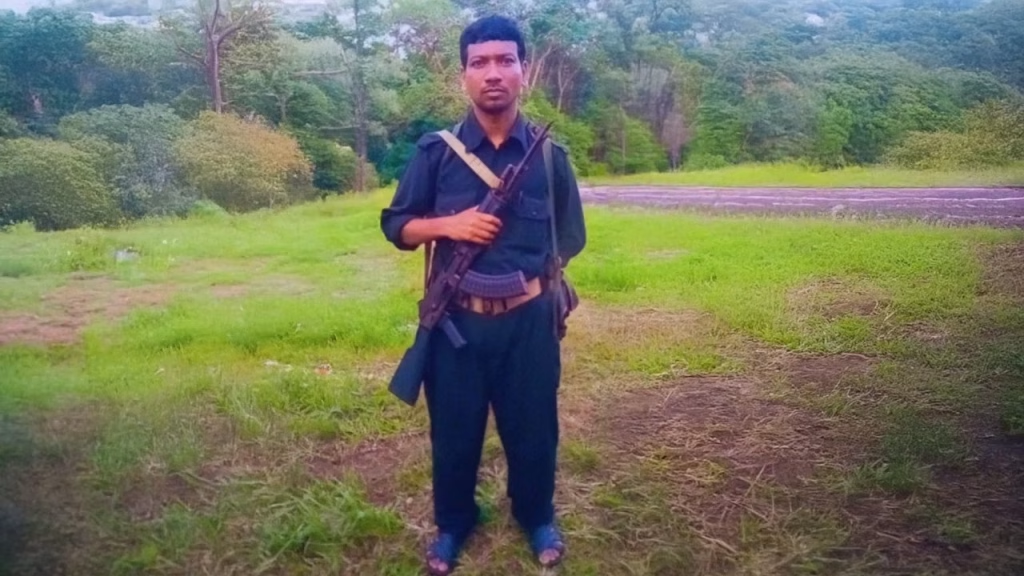
A native of Puvarti village, Hidma joined the Maoists as a Bal Sangham child recruit in 1991 and rose steadily through the organisation.
In the early 2000s, he was inducted into the People’s Liberation Guerrilla Army (PLGA) and eventually entrusted with command of the group’s most lethal fighting unit, PLGA Battalion No. 1.
Comprising more than 150 armed cadres hand-selected by him, this battalion engineered the most devastating attacks in Maoist history.
What made Hidma uniquely dangerous was his mastery of terrain, meticulous ambush planning, and an ability to move armed columns with military precision.
His tactics — layered security rings, pre-planned escape routes, and the use of forest ridgelines for cover — were replicated across Maoist strongholds.
His name is linked to every major Maoist attack in South Bastar:
- The 2010 Tadmetla massacre of 76 security personnel,
- The 2013 Darbha Valley ambush that decimated Chhattisgarh’s Congress leadership,
- The 2017 Burkapal attack, and
- The 2021 Tarrem encounter on the Sukma-Bijapur border.
These operations cemented Hidma’s reputation as the CPI (Maoist)’s most effective operational commander and earned him a rare distinction, becoming the youngest member of the group’s Central Committee.
Hidma’s influence also extended far beyond the battlefield. He controlled recruitment channels in remote forest villages, oversaw tactical instruction for new squads, and helped the organisation maintain resilience despite years of attrition.
Surrendered cadres describe him as the “spine” of the Maoist army, an ideologue, trainer and frontline commander rolled into one.
His wife, Madkam Raje, also killed in the encounter, played an important behind-the-scenes role, serving in political training units and maintaining communication networks during periods of intense security pressure.
Security forces say Hidma’s downfall was the result of two years of sustained joint operations across south Bastar, Telangana and Andhra Pradesh.
With the Indian government under Prime Minister Narendra Modi and Home Minister Amit Shah setting March 2026 as the target to eliminate Left-Wing Extremism, agencies intensified pressure on Maoist corridors, steadily shrinking Hidma’s safe zones and forcing him into unfamiliar terrain where he was eventually cornered.
While the Maoist movement has historically managed to reorganise after major losses, officers believe replacing Hidma’s deep territorial knowledge and battlefield experience will be exceptionally difficult.
Coming soon after the elimination of general secretary Basavaraju, the “brain” of the organisation, Hidma’s death represents a severe structural blow.
For villagers across Sukma and Bijapur, the reaction was immediate: cautious relief. For the first time in years, the shadow of the insurgency’s most feared commander has lifted, and with it, the hope of a quieter Bastar.
NOTE: Follow Defence.Capital on Arattai.
NOTE: Follow Defence.Capital on Telegram.
NOTE: Follow Defence.Capital on WhatsApp.
Share this:

Discover more from Defence.Capital
Subscribe to get the latest posts sent to your email.