
By N. C. Bipindra
New Delhi: It is official now. US President Donald Trump has effectively set up a contest between American F-35 and Russian Su-57 for India‘s big-ticket need for a fifth-generation fighter aircraft to catch up with arch-rival China on high-end combat jets.


Trump, after meeting Indian Prime Minister Narendra Modi in Washington, D.C., announced that the US is offering India the F-35, a fighter aircraft made by Lockheed Martin, the world’s largest arms maker. The offer comes close to the F-35 facing off against the Sukhoi-made Su-57 at the AeroIndia 2025 air show in Bengaluru between Feb. 10 and 14, 2025.
While the Su-57 did aerial manoeuvres at AeroIndia 2025 on all five days, the F-35 was forced to one such display on the second day of the air show and did fly-past on other days. The Su-57 stole the show and the hearts of all visitors, including executives from military aviation firms at AeroIndia 2025.
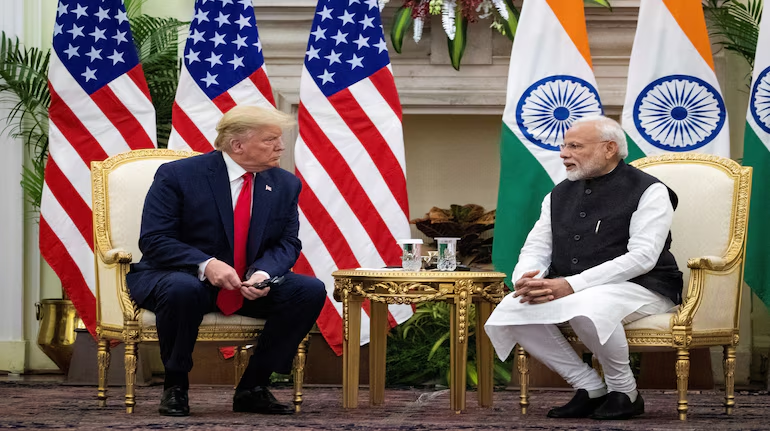
Trump’s announcement came at a press conference he held with Modi after their bilateral meetings during a working visit by the latter to the US. India’s Foreign Secretary Vikram Misri acknowledged the Trump administration announcement at a press briefing in Washington, D.C., but noted that the offer was at the proposal stage and the procurement process hasn’t started yet.
“Starting this year, we’ll be increasing military sales to India by many billions of dollars. We’re also paving the way to ultimately provide India with the F-35 stealth fighters,” Trump told a joint news conference with Indian Prime Minister Narendra Modi.
“On military sales to India, there is a process by which platforms are acquired. There is, in most cases, a request for proposals that is floated. There are responses to those. They are evaluated,” Misri said at the post-visit media briefing.

Pakistan jumped in to oppose the F-35 sale to India. In its weekly press briefing on Feb. 14, 2025, Pakistan’s Ministry of Foreign Affairs (MOFA) spokesperson said, “Pakistan is deeply concerned over the planned transfer of advanced military technologies to India. Such steps accentuate military imbalances in the region and undermine strategic stability.”
“I don’t think with regard to the acquisition of an advanced aviation platform by India, that process has started yet. So, this is currently something that’s at the stage of a proposal. But I don’t think the formal process in this regard has started yet,” he said.
The MOFA spokesperson added, “They remain unhelpful in achieving the objective of a durable peace in South Asia. We urge our international partners to take a holistic and objective view of issues of peace and security in South Asia and refrain from endorsing positions that are one-sided and deviate from ground reality.”
The F-35 versus Su-57 battle to meet the Indian requirement comes as India’s Defence Research and Development Organisation (DRDO) institution Aeronautical Development Agency (ADA) has just begun work on the fifth-generation twin-engine Advanced Medium Combat Aircraft (AMCA).
India’s quest for a fifth-generation fighter aircraft is not new, and it joined Russia‘s effort at building one under a bilateral agreement a decade ago. India had also invested US$300 million in the Fifth Generation Fighter Aircraft (FGFA) programme but it committed a huge mistake in withdrawing from the project at the last stage in favour of developing the AMCA.
If India had stayed with the FGFA programme, it would have been the first to get the export version of the Su-57 from Russia and leveled with the Chinese People’s Liberation Army – Air Force, which boasts two fifth-generation fighters in J-20 and J-35. China has also unveiled two so-called sixth-generation fighters in J-36 and J-xx.
Since 2005, India’s navy and air force have been discussing the F-35 as a possible addition to their respective fleets. However, what Trump essentially did was to tweak the export controls of the US to enable India to become a likely customer for Lockheed Martin for the F-35.
By the way, Lockheed Martin and Boeing Co. have offered their upgraded version of the F-16, rechristened as F-21, and the F/A-18 and F-15EX to India’s requirement to meet its 4++ generation fighter aircraft numbering 114 at least with a possible transfer of technology to make these aircraft in India.
Boeing Co. has previously lost the contest for the Indian Navy‘s requirement for a carrier-based combat jet to France’s Dassault Aviation, which has offered the Rafale-M jets to operate from INS Vikramaditya and INS Vikrant, India’s two operational aircraft carriers.
Before flying to the US, Modi was in Paris to meet with French President Emmanuel Macron when the two leaders discussed this deal, though a final announcement is awaited, as India’s highest decision-making body Cabinet Committee on Security (CCS) is yet to clear the deal.
The India-US joint statement, released after Modi completed his US visit, also mentions future deals later this year for the procurement of and co-production arrangements for ‘Javelin‘ Anti-Tank Guided Missiles and ‘Stryker‘ Infantry Combat Vehicles in India to rapidly meet India’s defence requirements.
The two sides also expect completion of procurement for six additional P-8I Maritime Patrol Aircraft to enhance India’s maritime surveillance reach in the Indian Ocean Region following the agreement on sale terms.
With these deals in the offing, the US would emerge as the largest arms supplier to India displacing the traditional long-term friend Russia. The US has already done nearly US$25 billion worth of arms deals with India since 2007.
To advance defence ties further, Trump and Modi announced plans to sign this year a new ten-year Framework for the US-India Major Defence Partnership in the 21st Century. Recognising that India is a Major Defence Partner with Strategic Trade Authorisation-1 (STA‑1) authorisation and a key Quad partner, the US and India will review their respective arms transfer regulations, including International Traffic in Arms Regulations (ITAR), to streamline defence trade, technology exchange and maintenance, spare supplies and in-country repair and overhaul of US-provided defence systems.
The leaders also called for opening negotiations this year for a Reciprocal Defence Procurement (RDP) agreement to better align their procurement systems and enable the reciprocal supply of defense goods and services. The leaders pledged to accelerate defense technology cooperation across space, air defense, missile, maritime, and undersea technologies, with the US announcing a review of its policy on releasing fifth-generation fighters and undersea systems to India.
Building on the US-India Roadmap for Defence Industrial Cooperation and recognising the rising importance of autonomous systems, the leaders announced a new initiative — the Autonomous Systems Industry Alliance (ASIA) — to scale industry partnerships and production in the Indo-Pacific.
The leaders welcomed a new partnership between Anduril Industries and Mahindra Group on advanced autonomous technologies to co-develop and co-produce state-of-the-art maritime systems and advanced AI-enabled counter Unmanned Aerial System (UAS) to strengthen regional security, and between L3 Harris and Bharat Electronics Limited for co-development of active towed array systems.
The leaders also pledged to elevate military cooperation across all domains — air, land, sea, space, and cyberspace — through enhanced training, exercises, and operations, incorporating the latest technologies. The leaders welcomed the forthcoming ‘Tiger Triumph‘ tri-service exercise (first inaugurated in 2019) with a larger scale and complexity to be hosted in India.
They also committed to breaking new ground to support and sustain the overseas deployments of the US and Indian militaries in the Indo-Pacific, including enhanced logistics and intelligence sharing, as well as arrangements to improve force mobility for joint humanitarian and disaster relief operations along with other exchanges and security cooperation engagements.
NOTE: Defence.Capital is available on Telegram. Please click here to subscribe
Share this:

Discover more from Defence.Capital
Subscribe to get the latest posts sent to your email.